







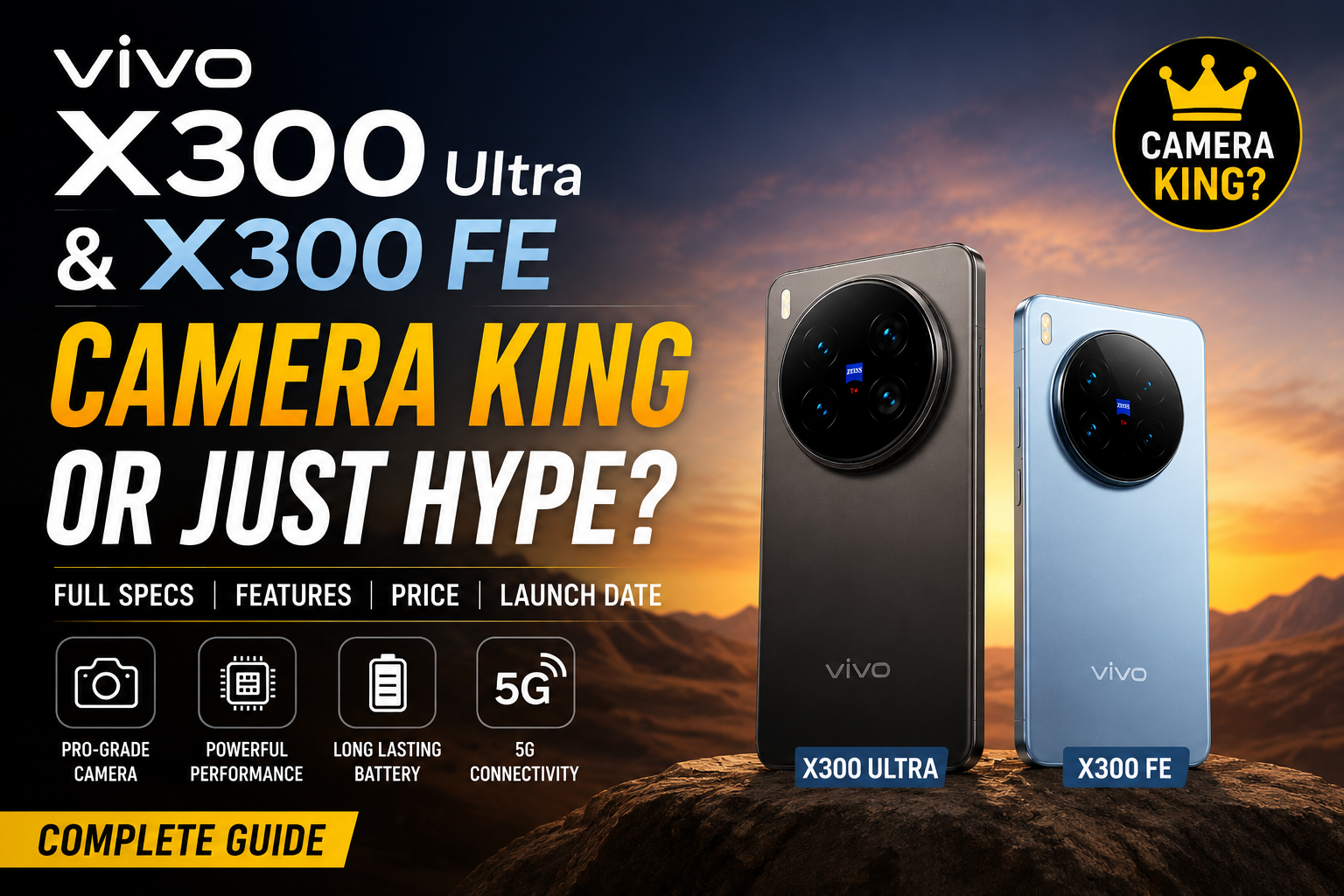
The smartphone camera wars just got a whole lot more interesting. On May 6, 2026, Vivo officially launched two of its most ambitious devices to date in India — the Vivo X300 Ultra and the Vivo X300 FE — and the tech world has been buzzing ever since. One is a no-holds-barred flagship camera powerhouse aimed squarely at professionals and enthusiasts. The other is a compact, more accessible sibling that still punches well above its weight class.
But are these phones genuinely changing the camera game, or is Vivo simply riding the wave of impressive spec sheets and marketing hype? In this deep-dive review and analysis, we’ll break down everything you need to know — cameras, performance, battery life, display, pricing, and where each device fits in the crowded 2026 smartphone landscape.
The Vivo X300 Series: A Bold Global Statement
Vivo has long been one of Asia’s most innovative smartphone brands, but its Ultra lineup has historically been a China-exclusive affair. With the X300 Ultra, that changes dramatically. This is the first time Vivo has launched its Ultra-tier flagship globally — including India, Europe, and several other key markets — signaling a serious push to compete with Samsung, Apple, and Xiaomi on the world stage.
The X300 FE (Fashion Edition), meanwhile, takes a different approach. It’s designed for users who want flagship-level performance and camera quality without the eye-watering price of a full Ultra device. Together, these two phones represent Vivo’s most comprehensive assault on the premium smartphone market yet.
Vivo X300 Ultra: Full Specifications at a Glance
| Feature | Specification |
|---|---|
| Display | 6.82-inch AMOLED, 2K resolution, 144Hz LTPO |
| Processor | Qualcomm Snapdragon 8 Elite Gen 5 |
| RAM / Storage | Up to 16GB RAM / 1TB Storage |
| Main Camera | 200MP Sony Lytia LYT-901, f/1.9, 35mm |
| Telephoto | 200MP Samsung ISOCELL HPB, f/2.7, 85mm |
| Ultrawide | 50MP Sony Lytia LYT-818, 14mm |
| Front Camera | 50MP |
| Battery | 6,600mAh / 100W wired / 40W wireless |
| OS | OriginOS 6 (Android 16) |
| Price (India) | ₹1,59,999 |
Vivo X300 FE: Full Specifications at a Glance
| Feature | Specification |
|---|---|
| Display | 6.31-inch LTPO AMOLED, 1.5K, 120Hz |
| Processor | Qualcomm Snapdragon 8 Gen 5 |
| RAM / Storage | 12GB RAM / 256GB–512GB Storage |
| Main Camera | 50MP ZEISS, IMX921 Sensor, OIS |
| Telephoto | 50MP Periscope, IMX882 Sensor, OIS, 5x optical |
| Ultrawide | 8MP |
| Front Camera | 50MP |
| Battery | 6,500mAh / 90W wired / 40W wireless |
| OS | Android 16 |
| Price (India) | ₹79,999 |
Camera Deep-Dive: The X300 Ultra — A True Camera King?
Let’s address the headline question head-on: Is the Vivo X300 Ultra actually the best camera phone of 2026? Based on everything reviewers have said so far, the answer is a resounding yes — at least when it comes to raw versatility and image quality.
The Dual 200MP Setup That Changes Everything
The story of the X300 Ultra’s camera begins with two extraordinary sensors. The 200MP Sony Lytia LYT-901 main camera is a first of its kind, paired with a massive 1/1.12-inch sensor that allows it to absorb significantly more light than previous generations. Paired alongside this is a 200MP Samsung ISOCELL HPB telephoto — the world’s first dual 200MP setup in a smartphone.
What does this mean in practice? It means you get extraordinary detail at virtually every focal length. The main camera’s 35mm equivalent focal length is a deliberate choice — more cinematic than the 24mm standard used by most competitors, and perfect for portraits and documentary-style shooting.
Zeiss Optics: The Difference Maker
Vivo’s collaboration with Zeiss continues to pay dividends. The X300 Ultra features what Vivo calls a “triple prime lens” system with focal lengths of 14mm, 35mm, and 85mm — all tuned by Zeiss for color accuracy, clarity, and optical performance. The Zeiss APO (apochromatic) design on the telephoto corrects color fringing, a common problem at high zoom levels, resulting in cleaner, sharper telephoto shots.
Telephoto That Defies Expectations
The 200MP telephoto camera is arguably the most jaw-dropping element here. It handles usable shots at 10x zoom with exceptional clarity, and with the optional Zeiss Telephoto Extender Gen 2 Ultra, you can push that to a mind-boggling 400mm equivalent — and even 340x digital zoom in extreme cases. For context, that’s approaching the territory of dedicated bridge cameras, from a device that fits in your pocket.
Video: Where the X300 Ultra Truly Shines
Camera aside, Vivo has gone all-in on video for the X300 Ultra. Every rear camera now supports 4K 120fps recording in Dolby Vision, which is extraordinary. Even the 50MP front camera can shoot 4K60 in Dolby Vision. There’s support for 10-bit Log video recording, APV codec, custom LUT previews in real-time, and compatibility with ACES workflow — the same color management pipeline used in Hollywood filmmaking.
A redesigned Pro Video mode gives you granular control over nearly every parameter, making the X300 Ultra one of the most capable video tools you can fit in your pocket. For vloggers, content creators, and even semi-professional filmmakers, this phone is genuinely compelling.
Where the Camera Falls Short
No phone is perfect, and the X300 Ultra has a few camera quirks worth noting. The default color profile leans vivid — almost oversaturated — though a natural/authentic mode does an excellent job of dialing that back. The camera also lacks the hardware shutter button that appeared on the X200 Ultra, which is a step backward for quick-draw photography. Selfie performance, while generally excellent, can exhibit some selective softening on facial patches — fine if you don’t scrutinize, slightly annoying if you do.
Vivo X300 FE Camera: Compact, But Not Compromised
The X300 FE takes a very different approach to camera design. Rather than chasing megapixel records, it delivers a trio of ZEISS-tuned cameras that prioritize real-world usability.
The headline here is the 50MP periscope telephoto with 5x optical zoom and OIS — a feature rarely seen at this price point. It supports up to 100x digital zoom, and Vivo is even offering a compatible 200mm teleconverter lens accessory for India buyers, giving the FE a surprising degree of zoom flexibility. The 50MP main camera uses Sony’s IMX921 sensor, known for its excellent low-light performance, while OIS ensures that handheld shots remain sharp even in challenging conditions.
For a phone at ₹79,999, the X300 FE’s camera system is genuinely impressive. It’s not trying to be the X300 Ultra — but it doesn’t need to be. It’s a legitimate camera phone in its own right, with IP69 rating (superior even to the standard IP68) and the brand recognition of ZEISS optics.
Performance: No Compromises at Either Level
Both phones are built around Qualcomm’s latest silicon. The X300 Ultra runs the Snapdragon 8 Elite Gen 5, and paired with up to 16GB of LPDDR5X RAM and 1TB of UFS 4.1 storage, it handles everything from 4K video editing to high-fidelity gaming without breaking a sweat. In benchmarks, it trades blows with the Samsung Galaxy S26 Ultra, its closest direct rival.
The X300 FE runs the Snapdragon 8 Gen 5 — a slightly more efficiency-focused chip that still delivers flagship-tier performance. With 12GB of LPDDR5X Ultra RAM and UFS 4.1 storage, it’s no slouch. For most everyday tasks — even demanding gaming — the difference between the two processors will be invisible to most users.
Display: Two Very Different Experiences
The X300 Ultra features a 6.82-inch AMOLED panel with 2K resolution and a 144Hz LTPO refresh rate — one of the highest refresh rates available on any flagship right now. It supports HDR10+ and Dolby Vision, making it excellent for media consumption. The flat 2.5D design gives it a clean, modern look.
The X300 FE offers a 6.31-inch LTPO AMOLED display with 1.5K resolution and 120Hz refresh rate. While slightly smaller and lower resolution than the Ultra, it’s still a premium display that delivers punchy colors, high brightness, and fluid scrolling.
Both screens are excellent for their respective tiers. The FE’s compact 6.31-inch form factor also makes it one of the more pocket-friendly flagship options in a world dominated by oversized slabs.
Battery Life: Vivo Leads the Pack
Battery life is where both phones genuinely stand out in a crowded market.
The X300 Ultra packs a 6,600mAh battery — one of the largest in the ultra-premium segment — with 100W wired charging and 40W wireless charging. For comparison, the Samsung Galaxy S26 Ultra only packs a 5,000mAh battery with 60W wired charging. That’s a 32% larger battery with faster charging at a higher price — a compelling argument for Vivo.
The X300 FE is no slouch either, shipping with a 6,500mAh battery — approximately 51% larger than the Samsung Galaxy S26 (4,300mAh) and a staggering 76% larger than the Apple iPhone 17 (3,692mAh). With 90W fast charging and 40W wireless charging, you can top up quickly and rarely worry about running out of juice during the day.
Both phones offer five major OS upgrades and seven years of security patches — a strong software longevity commitment that rivals Google’s Pixel promise.
Vivo X300 Ultra vs. The Competition
How does the X300 Ultra stack up against its ultra-premium rivals?
vs. Samsung Galaxy S26 Ultra (₹1,39,999)
The Galaxy S26 Ultra is ₹20,000 cheaper than the X300 Ultra and brings its own strengths — a quad-camera system, Samsung’s excellent S Pen integration, and the trusted One UI software experience. However, the X300 Ultra leads meaningfully in battery capacity, charging speed, display refresh rate, and raw camera versatility. Samsung’s color science is more restrained and natural, while Vivo’s Zeiss tuning delivers more dramatic, social-media-ready images.
vs. Apple iPhone 17 Pro Max (₹1,69,999)
Apple’s iPhone remains the gold standard for video consistency, ecosystem integration, and software polish. But the X300 Ultra offers dramatically more camera flexibility, a far larger battery, faster charging, and a higher refresh rate display. The iPhone wins on brand recognition and iOS exclusives; Vivo wins on pure hardware value.
vs. Xiaomi 17 Ultra (₹1,39,999)
Xiaomi’s Leica-branded flagship is another strong competitor with its continuous zoom lens system. The X300 Ultra edges it out on video capabilities and the modular telephoto accessory ecosystem, while Xiaomi counters with a slightly lower price and the trusted Leica color science.
Vivo X300 FE: Who Is It For?
The X300 FE sits in a fascinating position. At ₹79,999, it’s priced against the Samsung Galaxy S26 and below the Apple iPhone 17, yet it brings a 6,500mAh battery, Snapdragon 8 Gen 5, ZEISS optics, IP69 rating, wireless charging, and an LTPO display — features that many phones in this category simply don’t offer.
It’s ideal for:
- Users who want a compact flagship without the bulk of an Ultra-tier device
- Photography enthusiasts who want ZEISS-quality optics at a reasonable price
- Battery-conscious users who are tired of charging their phone twice a day
- Students and young professionals who want flagship specs without flagship prices
The X300 FE’s main limitation is its ultrawide — an 8MP sensor is underwhelming by 2026 standards, especially when the main and telephoto cameras are so capable. The software experience (OriginOS / FuntouchOS) also takes some getting used to compared to Samsung One UI or stock Android.
Design & Build Quality
The X300 Ultra is a bold, heavy phone at around 237g. The camera module on the back is enormous — one of the largest ever seen on a smartphone — a natural consequence of housing two 200MP sensors and Zeiss lenses. It’s available in Black and Green, with a metal “biscuit-style” camera bump featuring knurled texture and engraved Zeiss lettering. It’s the kind of phone that turns heads.
The X300 FE is more subdued but equally premium in finish, available in Urban Olive, Lilac Purple, and Noir Black. Its compact 6.31-inch form is a deliberate counterpoint to the oversized flagship trend, and Vivo has protected the front with Gorilla Glass 7i.
Software: The One Weak Link
Both phones ship with OriginOS 6 (China) or FuntouchOS (global), based on Android 16. Vivo’s skin has improved considerably, offering features like Flip Cards wallpaper, per-app volume controls, custom brightness per app, and motion sickness reduction. However, it still feels more iOS-inspired than some reviewers prefer, and editing quick settings or managing widgets remains less intuitive than Samsung One UI.
The five-year OS update promise and seven years of security patches are commendable, and Vivo has also invested in a capable AI camera assistant — though it’s less sophisticated than Google’s Pixel AI camera guidance, functioning more like advanced scene recognition than proactive shooting advice.
The Photography Kit Ecosystem
One of the most exciting aspects of the X300 Ultra is Vivo’s modular photography accessory ecosystem. The optional Photography Kit includes:
- Zeiss Telephoto Extender Gen 2 Ultra (400mm) — “Big Gun”
- Zeiss 200mm Teleconverter (compact “Lipstick” design)
- SmallRig video cage with dual handgrips and shutter control
- Filter rings and lens caps
- A cooling fan for extended 4K recording sessions
- Leather quick-release strap
This transforms the X300 Ultra from a smartphone into a serious creative platform. The 200mm teleconverter is also available in India for X300 FE owners, giving the more affordable device a taste of the Ultra’s zoom capabilities.
Should You Buy the Vivo X300 Ultra or X300 FE?
Buy the Vivo X300 Ultra if:
- You’re a serious mobile photographer or videographer
- You want the absolute best camera system money can buy in 2026
- 4K Dolby Vision video and log recording matter to you
- You’re comfortable with a large, premium device above ₹1.5 lakh
Buy the Vivo X300 FE if:
- You want flagship specs in a compact body under ₹80,000
- Long battery life is a top priority
- ZEISS optics and 5x optical zoom at this price excite you
- You don’t need the extreme video and zoom capabilities of the Ultra
Final Verdict
The Vivo X300 Ultra is not hype — it is genuinely the most versatile and capable camera phone of 2026, full stop. With dual 200MP sensors, Zeiss-tuned optics, class-leading 4K Dolby Vision video from every camera, a modular accessory ecosystem, and a massive battery that embarrasses its competitors, it earns its premium price tag for the right buyer. The sky-high cost and OriginOS learning curve are real considerations, but for anyone who shoots with intention, this phone is a remarkable tool.
The Vivo X300 FE is a different kind of success story — a compact flagship that delivers ZEISS optics, a massive 6,500mAh battery, and Snapdragon 8 Gen 5 performance at a price that makes Samsung and Apple look overpriced. It’s not perfect, but it’s one of the best-value flagship smartphones of the year.
Whether you’re a content creator chasing the ultimate mobile camera or a power user who wants more phone for less money, Vivo’s X300 lineup in 2026 deserves serious consideration.
Frequently Asked Questions
Q: Is the Vivo X300 Ultra available in the US? A: No. Vivo has not announced a US launch for the X300 Ultra. It is available in India, parts of Europe, and several other markets.
Q: What is the price of the Vivo X300 FE in India? A: The Vivo X300 FE is priced at ₹79,999 in India, available on Amazon and Flipkart.
Q: Does the Vivo X300 Ultra beat the Samsung Galaxy S26 Ultra in cameras? A: Based on current reviews, the X300 Ultra offers more camera versatility, higher megapixel counts, and superior video capabilities, while Samsung’s S26 Ultra provides more natural color science and a more polished software experience.
Q: Does the Vivo X300 FE support wireless charging? A: Yes. The X300 FE supports 40W wireless charging in addition to 90W wired fast charging.
Q: How many years of software updates does Vivo promise? A: Both the X300 Ultra and X300 FE come with a promise of five major OS upgrades and seven years of security patches.
For more smartphone comparisons, tech reviews, and buying guides, explore our other articles at WriteForUsHub. Interested in contributing?