







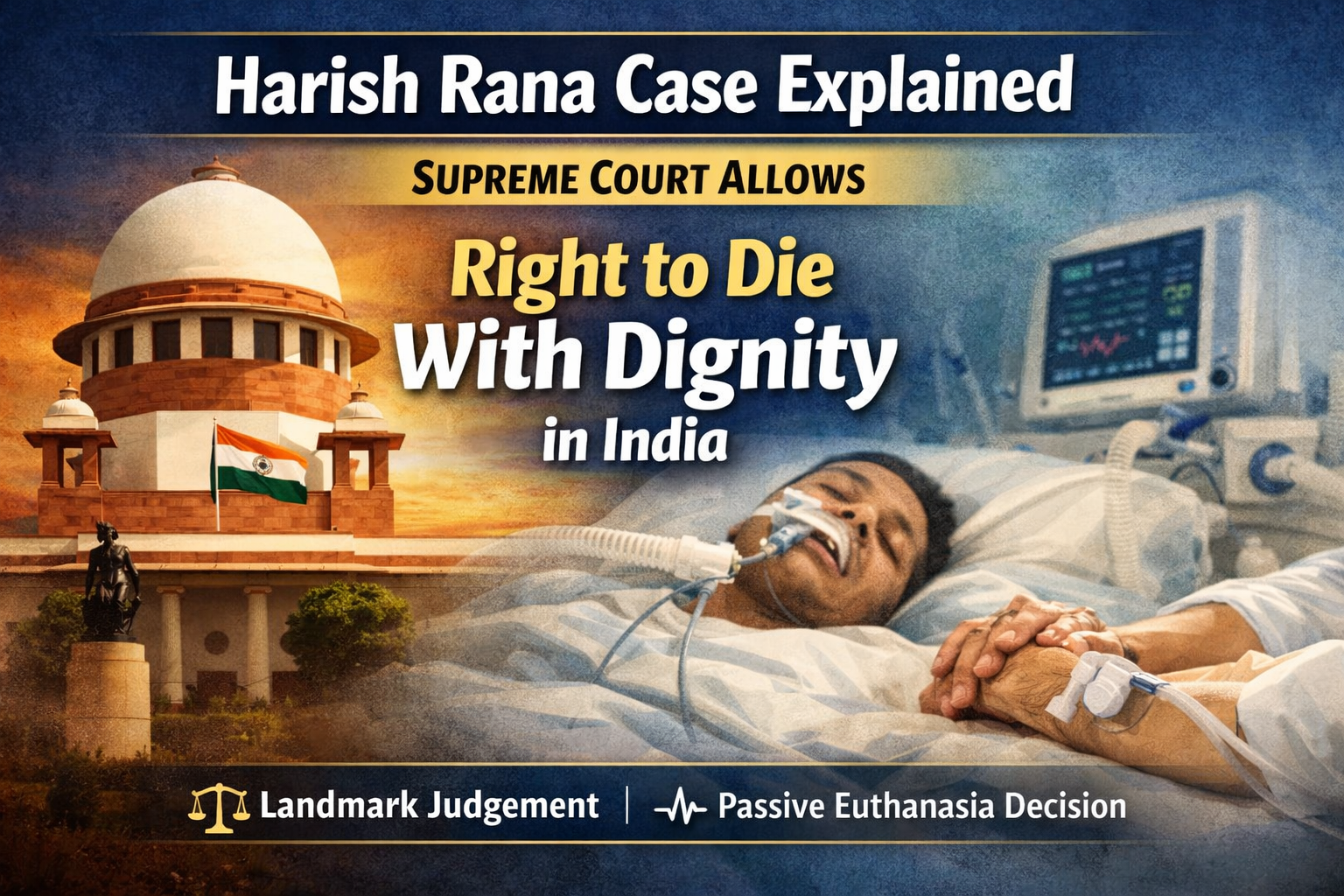
The Harish Rana case has recently become one of the most discussed legal and ethical issues in India. The case brought national attention to the sensitive subject of passive euthanasia and the right to die with dignity. With the Supreme Court of India allowing the withdrawal of life support in this case, it has sparked widespread debate among legal experts, medical professionals, and the general public.
This landmark decision highlights the evolving interpretation of Article 21 of the Indian Constitution, which guarantees the Right to Life and Personal Liberty. Over time, the judiciary has expanded this right to include the concept of dying with dignity, especially in cases where recovery is medically impossible.
In this blog, we will explain the Harish Rana case, its background, the Supreme Court’s decision, and why it is considered a landmark moment in India’s legal history.
Background of the Harish Rana Case
Harish Rana was a young man whose life changed dramatically after a tragic accident. Reports indicate that he suffered a severe brain injury following a fall, which left him in a permanent vegetative state. In such a condition, patients lose awareness of their surroundings and cannot communicate or respond, though basic bodily functions may continue with medical support.
For several years, Harish Rana remained dependent on life-support systems, including medical feeding and breathing assistance. Doctors confirmed that there was no realistic chance of recovery and that his condition was irreversible.
His family faced an extremely painful and difficult situation. Watching a loved one remain in such a condition for years placed emotional and financial strain on them. Eventually, the family approached the courts seeking permission to withdraw life-support treatment, arguing that Harish Rana should be allowed to pass away with dignity rather than remain in prolonged suffering.
What Is Passive Euthanasia?
To understand the significance of the Harish Rana case, it is important to understand the concept of passive euthanasia.
Passive euthanasia refers to the withdrawal or withholding of life-sustaining medical treatment, allowing the patient to die naturally. This may include:
-
Stopping ventilator support
-
Removing artificial feeding systems
-
Discontinuing certain medications or treatments
Unlike active euthanasia, where a deliberate action is taken to end life, passive euthanasia simply allows the natural process of death to occur when recovery is impossible.
In India, active euthanasia remains illegal, but passive euthanasia has been permitted under strict guidelines following several Supreme Court rulings.
Legal Journey of the Case
The Harish Rana case reached the judiciary after his family filed a petition requesting permission for passive euthanasia. The petition argued that continuing life support in a situation with no chance of recovery violates the dignity of the patient.
Medical experts examined Harish Rana’s condition and confirmed that he was in a permanent vegetative state with no medical hope of improvement. After evaluating the medical evidence and the emotional circumstances of the family, the case eventually reached the Supreme Court of India.
The court examined several important questions:
-
Does the right to life include the right to die with dignity?
-
Should families have the right to request withdrawal of life support in irreversible cases?
-
What safeguards are necessary to prevent misuse of euthanasia laws?
These questions are not only legal but also deeply ethical and philosophical.
Supreme Court Decision
After reviewing the case, the Supreme Court allowed passive euthanasia for Harish Rana. The court permitted doctors to follow a medically supervised process for withdrawing life support.
The decision was based on the principle that prolonging life artificially in cases where recovery is impossible may violate human dignity.
The court also emphasized the importance of medical supervision and legal safeguards to ensure that such decisions are made responsibly and ethically.
In its observations, the court reaffirmed that the Right to Life under Article 21 includes the right to live with dignity and, in certain circumstances, the right to die with dignity.
Connection to Previous Landmark Cases
The Harish Rana case follows the legal path set by earlier landmark judgments in India.
One of the most famous cases related to euthanasia was the Aruna Shanbaug case in 2011. Aruna Shanbaug, a nurse who remained in a vegetative state for decades after a brutal assault, became the center of a major legal debate.
In that case, the Supreme Court allowed passive euthanasia under strict conditions, setting guidelines for hospitals and courts.
Later, in 2018, the Supreme Court further strengthened this principle by recognizing the legality of living wills, allowing individuals to specify their medical wishes in advance if they become incapacitated.
The Harish Rana case reinforces these earlier decisions and demonstrates how the judiciary continues to interpret the Right to Life and Dignity in modern healthcare situations.
Ethical and Social Debate
The Harish Rana case has generated strong reactions across India. While many support the decision as a compassionate and humane approach, others worry about the ethical implications.
Supporters argue that:
-
Patients should not be forced to remain on life support when recovery is impossible.
-
Families should have the right to make compassionate decisions.
-
Medical technology should not prolong suffering unnecessarily.
On the other hand, critics raise concerns such as:
-
Possible misuse of euthanasia laws
-
Pressure on families or patients
-
Moral and religious objections
These debates highlight the complexity of the issue and the need for clear legal and medical guidelines.
Why the Harish Rana Case Is Important
The Harish Rana case is considered significant for several reasons.
First, it reinforces the legal concept of “Right to Die with Dignity.”
Second, it highlights the importance of medical ethics in modern healthcare, where technology can keep patients alive even when recovery is impossible.
Third, it provides guidance for future cases involving patients in long-term vegetative states.
Most importantly, the case has sparked nationwide conversations about compassion, dignity, and the responsibilities of families, doctors, and the legal system.
The Role of the Judiciary in Protecting Human Dignity
The Indian judiciary has played a crucial role in balancing legal principles, medical science, and ethical considerations. Through cases like Harish Rana, the courts are attempting to ensure that human dignity remains at the center of healthcare decisions.
By allowing passive euthanasia under strict safeguards, the courts aim to prevent unnecessary suffering while also protecting vulnerable individuals.
This approach reflects a broader global conversation about patient rights, end-of-life care, and medical ethics.
Conclusion
The Harish Rana case represents an important moment in India’s legal and ethical landscape. It has once again highlighted the complex relationship between life, dignity, medicine, and law.
While the topic of euthanasia remains sensitive and controversial, the Supreme Court’s decision demonstrates a compassionate approach toward patients who have no hope of recovery.
As medical technology continues to evolve, society will increasingly face difficult questions about how life should be preserved and when dignity should take priority.
The Harish Rana case serves as a reminder that legal systems must constantly adapt to protect both human life and human dignity.
About WriteForUsHub
This article is published in collaboration with WriteForUsHub, a platform dedicated to sharing insightful articles, trending topics, and informative content across multiple industries.
If you enjoy reading well-researched blogs on legal developments, current affairs, technology, business, and trending topics, WriteForUsHub welcomes contributors who want to share their knowledge and ideas with a global audience.
Whether you are a writer, blogger, or industry expert, WriteForUsHub provides a space to publish meaningful content and reach a wider readership.