








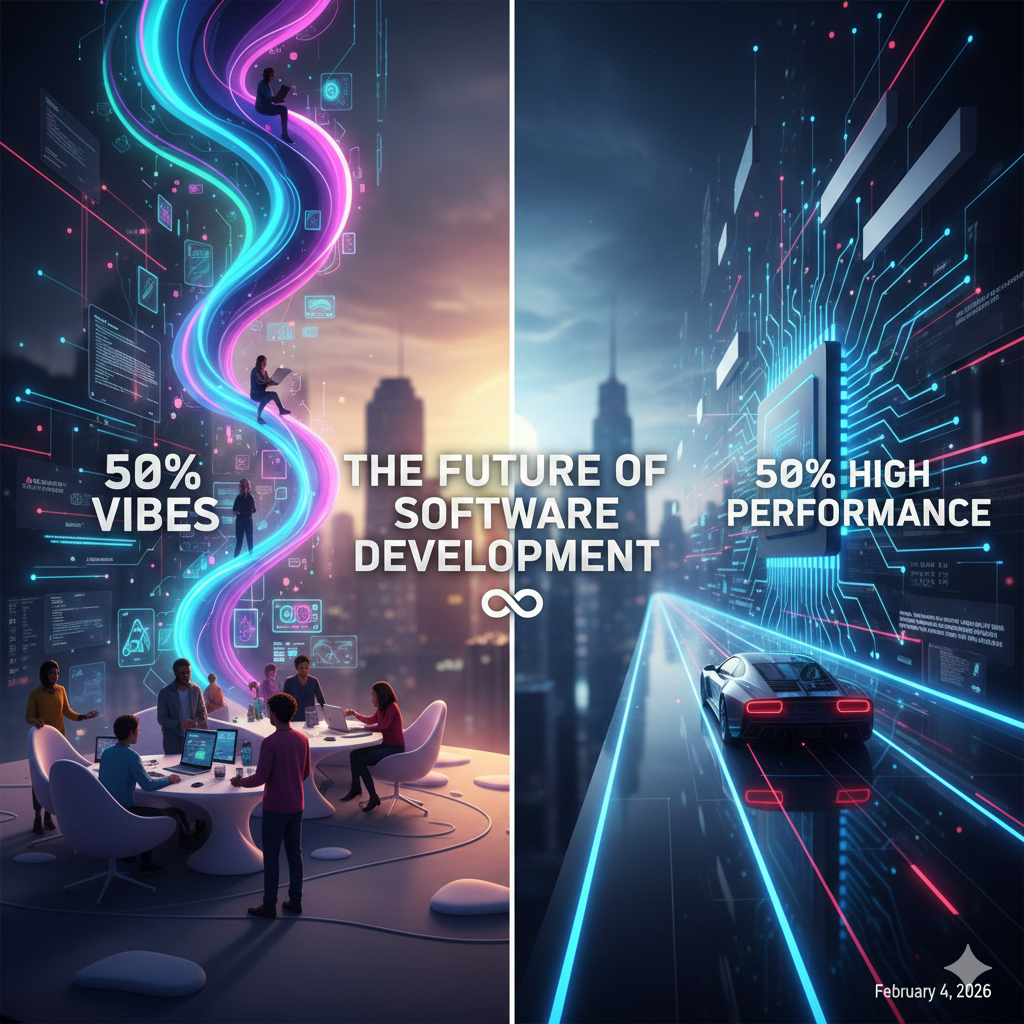
2025 saw the notorious Vibe coding spread its tentacles across the software development landscape. What was touted as a software engineering killer, undermining the business models of software service providers, ended up becoming a trusted tool that accelerated deals for software providers.
If “vibe coding accelerates deals” is news to you, then let me provide the context
Before Gen AI entered the foray, the application development industry had quite a linear story. Tech/non-tech founders and enterprises approached software providers with a half-explored need. The providers tagged along to help them create demos, POCs, and prototypes, till it evolved into a full-fledged application.
But when AI, especially vibe coding, entered the scene in early 2025, there was a dramatic shift. Startups and enterprises could suddenly chat their way into creating an application. This sounded magical, and to an extent, it was true. There was a surge of vibe coding tools that promised to churn out applications in hours, which rocked the software development landscape.
But the providers were neither laid back nor cynical. Instead, they embraced the tech in their coding practices. For instance, we saw software conglomerates announcing formal partnership with vibe coding startups despite stories that announced doomsday for SaaS and software services. Right through the year, vibe coding startups were on a roll amassing investments and saw exponential traction among developers. However, the analysts patiently waited till the end of (Vibe Coding) hype cycle. When 2025 came to a close, they saw a clear consistent pattern emerge to light.
Vibe Coding & Sound Engineering Hygiene – Do They Go Hand in Hand?
Vibe coding is good for prototyping your ideas, there is no debate there. However, expecting the vibe-coded app to automatically adhere to the core tenets of software engineering hygiene (security, reliability, maintainability) is wishful thinking. These three qualities don’t emerge by default but are natural outcomes of deliberate, disciplined engineering practices.
When building an application through vibe coding, There are chances that several foundational questions go unanswered:
- Were the right architectural decisions made?
- Was the code vigorously tested for various edge cases and failure scenarios?
- Is there sufficient documentation to capture the intent and design rationale?
These are just a few of the many factors that can come back to haunt teams later if not addressed at the start of the application development.
Consider an example that best illustrates this scenario:
You build an application using a vibe coding tool. Then an unhandled edge case suddenly brings it down, leaving you tracing logic at 2:00 a.m. Who’s to guarantee that a one-hour debugging session won’t stretch into fifteen hours, snowball into a fifteen-day refactoring exercise, and ultimately force a fifteen-month rebuild?
So, can we conclude that vibe coding is just for creating throwaway demos?
Not quite and it would be a mistake to undermine the tech. Vibe coding will undoubtedly mature in the coming years, but even currently, it signals a clear shift in how customers assess software service providers.
Startups or enterprise customers are most likely to have seen the gist of the end-product – a bare minimum prototype they have put together that resembles the end product.
Armed with this prototype, they will approach the service providers to build the rest of the application.
Are customers going to vibe code to assess software vendors?
Yes, it may sound counterintuitive but it is true. Let’s rewind a little to better understand this swing.
Prior to 2025, customers typically defined requirements before deciding to build or buy. This process took ages, requiring countless trial and error cycles. Now the inverse is set to happen. Customers are going to build something lightweight with AI, get a visceral understanding of the actual product, and only then approach software vendors to build the enterprise-grade version.
Note the important nuance here. Calling this step “building” is somewhat misleading, when the vibe coded version is only closer to a throwaway demo than the actual enterprise-grade product. Yet it serves a critical purpose: it helps customers validate whether the problem really matters, understand which features are essential, and make informed decisions before committing to full-scale development.
50% Vibe Coding, 50% High Coding
Customers may have completed half the journey but they are acutely aware that the remaining half is the hardest. The boundary conditions, non-happy path scenarios, fault tolerance, security considerations, runtime efficiency, and scalability behavior make up the remaining bulk that transforms the bare minimum prototype into an enterprise-grade application.
This dynamic ultimately benefits all parties involved. Vibe coding accelerates problem discovery by removing much of the guesswork from product definition.Customers arrive better informed with greater clarity on what they want to build. And when enterprise-grade development begins, teams work from the concrete reference point of the vibe-coded prototype, rather than abstract requirements.