







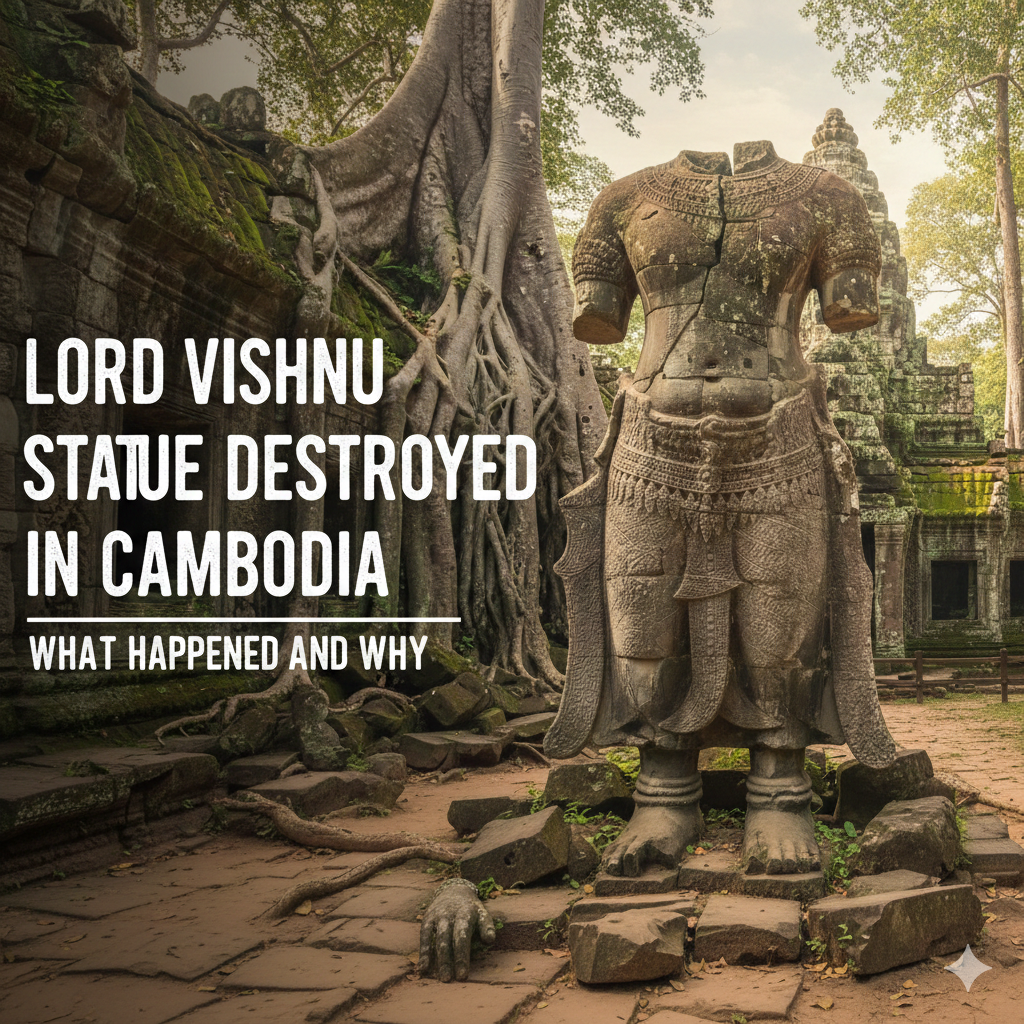
The recent reports of a Lord Vishnu statue being demolished in Cambodia are attracting publicity in South Asia and the Hindu world in general. Being the ancient country with ancient Hindu and Buddhist temples, Cambodia is the country of numerous old temples and sculptures, which demonstrate centuries-old cultural links with India. The destruction of such artifact calls into question the issue of heritage preservation, historical responsibility and cultural respect.
This paper describes the event, the location of the event, the significance of the statue, and the implications of this event on the protection of cultural heritage in straightforward and objective manner.
History: Hinduism in Cambodia
Cambodia is a country with strong affiliation with Hinduism that traces its way more than a thousand years ago. Hinduism had an influential impact on Cambodian art, architecture, and politics between the 1 st and the 14 th century.
Evidence of this historical influence is found in temples like Angkor Wat which were initially a temple of Lord Vishnu. However, a large number of sculptures of Hindu images exist in the ancient temple locations in Cambodia, such as Vishnu, Shiva, and Brahma.
Due to this rich history, any act of destruction to the Hindu statues is not only a religious question but also a loss of world heritage.
What has become of the Lord Vishnu Statue?
It was reported that a statue of Lord Vishnu in one of the ancient sites in Cambodia was destroyed or seriously damaged. The incident became known when photos and videos rolled on the social media indicating the broken state of the statue.
Although the authorities are still yet to explain the actual circumstances, initial details indicate that the statue might have been destroyed because of:
- Negligence or mishandling by human beings
- Vandalism
- Unlawful excavation or theft attempt
- Weakness or failure to conserve structurally
The authorities have said that they are investigating to find out the precise cause and responsibility.
Where Did the Incident Occur?
The statue was said to have been discovered in or around an ancient temple or archeological location relating to the Hindu history of Cambodia. A large number of these sites occur in areas around Angkor as well as other heritage areas.
The problems that may exist in such places include:
- Limited security
- Environmental damage
- Inadequate finances to conserve
- Introduction to illicit artifact trade
This exposes old statues especially to danger.
What was so important about the Lord Vishnu Statue?
The statue, which was destroyed, was not only a religious artifact but also an archeological and historical one.
Religious Significance
One of the main gods of Hinduism is Lord Vishnu who is referred to as the protector of the universe. To the devotees, images of Vishnu are a symbol of balance, protection and divine order.
Cultural and Historical Significance
- The statue was an indication of ancient art
- It was a reflection of the Hindu history in Cambodia
- It was a connection between the Indian and Southeast Asia cultures
Such statues enable the researcher to know more about the religious practices, the art styles, and the history of political systems in ancient kingdoms such as Khmer Empire.
Potential Causes of the Destruction
Although research is still in progress, researchers cite a number of potential reasons:
1. Lack of Proper Conservation
There is poor conservation and most of the ancient statues are left to the effects of weather, erosion and structural decay.
2. Illegal Artifact Trade
Southeast Asia has also had its problems of smuggling of ancient statues. Statues are also in other instances, destroyed in the process of illicit removal.
3. Vandalism or Negligence
Accidental harm by guests or deliberate vandalism cannot be eliminated.
4. Development or Construction Activities.
The unprotected heritage sites are often damaged by nearby infrastructure or land-use activities.
Response among the Devotees and the Experts of Culture
The event has raised eyebrows and heartbreak in the hearts of the cultured people, historians and cultural conservation people.
- There have been calls by numerous people to protect heritage sites more stringently
- Experts note the necessity of international collaboration
- Awareness and education are emphasized in cultural groups
The responses of the social media reveal that people strongly demand accountability and clean-up operations, and they are encouraged not to spread misinformation.
The Responsibility of Cambodia to the Protection of The Heritage
The most significant archaeological sites in the world belong to Cambodia. Protecting them requires:
- Stronger site security
- Funding conservation at an increased level
- Experienced heritage managers
- The illegal trade is to be dealt with strictly
The fact that the Lord Vishnu statue was destroyed shows that there is an urgent necessity to develop better policies on management of heritage.
World Significance of Ancient Statues Preservation
Ancient statues are not only the heritage of a particular country or a religion; they are the history of humanity.
Preserving them helps:
- Maintain cultural identity
- Enhance responsible tourism
- Educate future generations
- Make the world more culturally respectful
The international bodies such as UNESCO usually emphasize that the conservation of heritage is a collective endeavor.
Can the Statue Be Restored?
In others, broken statues may be repaired in part with:
- Original fragments
- Historical documentation
- The high conservation methods
Restoration is however subject to:
- Extent of damage
- Availability of materials
- Expert assessment
In this case, authorities are supposed to determine the possibility of restoration.
Lessons from the Incident
This accident is a reminder of the fact that:
- Old heritage sites are weak
- It is not about the enforcement of the law but rather awareness
- The respect of culture should be international
- The maintenance process is a daily affair
Conclusion
The case of demolition of the Lord Vishnu statue in Cambodia concerns all the lovers of heritage, historians and devotees all over the world. Outside the religious feelings, the event is a loss to the history and culture. The preservation of such invaluable artifacts needs good conservation policies, awareness of the people and international collaboration. With debates raging about accountability and restoration, websites such as writeforushub are determined to post transparent, respectful, and educative materials on key issues of cultures around the world.
Questions and Answers on Lord Vishnu Statue Destroyed in Cambodia
1. Whatever became of the statue of Lord Vishnu in Cambodia?
It is claimed that the statue was destroyed or damaged seriously at some ancient location; there is an ongoing investigation.
2. Where was the statue located?
It was found in close proximity or in an archaeological site or historic temple in Cambodia.
3. Why is Lord Vishnu significant in Cambodian history?
In ancient Cambodia, particularly in the Khmer Empire, Hinduism was a significant religion.
4. Was it a deliberate destruction?
The precise cause is not established it was either negligence, vandalism or illegal activity.
5. Do we expect to find Hindu temples in Cambodia?
Yes, most of the ancient temples such as the Angkor Wat are of Hindu origin.
6. Can the statue be restored?
The restoration can be considered in case of damage and fragments are available.
7. Who does the protecting of such statues?
There is a collective responsibility of local authorities, heritage departments and international bodies.
8. Does this have an impact on Cambodian tourism?
The cultural tourism may be affected by such incidents when the security of the heritage is challenged.
9. Do they steal and damage ancient statues frequently?
Yes, it is a fact that illegal trade of artifacts is common in most areas.
10. Where are the readers to get validated updates regarding such incidences?
Based on the official governmental reports, archaeological units, and reliable sources in the news.